STEAM Room Storage

Updated: Jan 1

With nearly 500 students visiting our STEAM room every week, it’s important to have a variety of recyclables and materials on hand for engineer design process challenges.
Students love shopping for the “just right” pieces that will help to bring their innovation to life.
We have a variety of recyclables that we collect, and storing them in a way that makes them easily accessible to students (or me) is important.
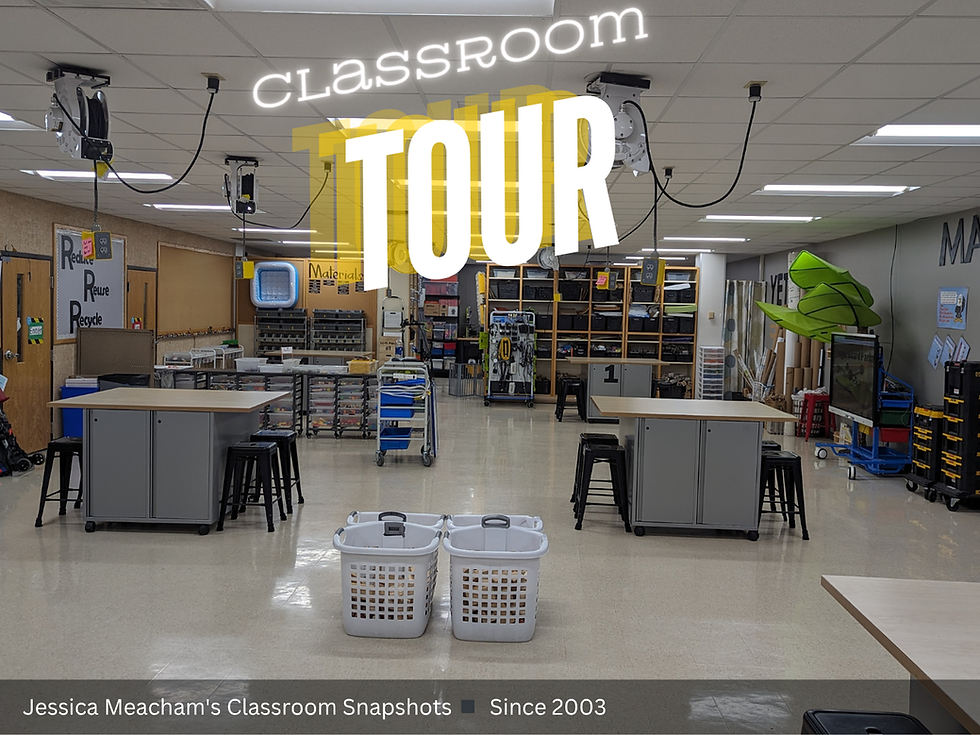
Recyclables Storage: When we began our STEAM program, we held two “Community Supply Drives” in an effort to build our collection. We still have one major collection drive a year (August Open House), and to supplement, I aim to create a community of collectors — encourage students/families to collect “on the go” and bring in when it makes sense.
When our selection seems to be dwindling overall, I bring in my collection bag from the week and share what items I was able to collect over the past week. I encourage students to designate a special area in their house and add things to their box or bag. Students drop off items in our “Reduce, Reuse, Recycle” bin area. Community members/parents drop off items in our school office.
Tools & Supplies Storage: When I transitioned to STEAM teacher, after having taught first grade for many years, I brought all the storage bins and drawers with me and reused them. What once housed books and math/literacy station materials now houses craft supplies, tape, glue, etc. At first I labeled all the bins/drawers and shelves, but I found out that the bins needed to be more flexible, so I’m slowly removing all labeling. Our 3D printers and laser cutters are stored on workbenches from Amazon and a 3D printer cart from Copernicus.
Engineering “Toys” Storage: Clear storage containers is my favorite way to store items. We have quite a few engineering “toys” that students can use not only for engineering challenges, but also for free choice time. Our LEGOS are stored in a Copernicus Reading Book Browser Cart that I had when I was a first grade teacher. I labeled the shelves and bins with vinyl letters so students and volunteers could quickly and easily identify where the containers go.
Robotics & iPads Storage: I love clear storage for as many things in our classroom, if possible. We have two carts that house several things (LittleBits, Ollies, Spheros, Dash/Dot, Ozobots, Bee Bots, and Edison robots. Copernicus robotics storage helps store our class sets of Dash and Sphero robots. We also have their Tech Tub Easel which houses our iPads. The reverse side of the easel has pegboard that stores all our chargers and extension cords.
What are your favorite ways to store classroom items?



What draws my attention to building management skills through practical situations is the possibility of making an unfamiliar subject feel closer to everyday life. A realistic scenario can expose how different decisions affect a team's work. I would keep that thought nearby when looking for ideas about management skills training. I am more curious about the process than a polished result, because the steps in between are usually where questions appear. Which situations are most useful for practising management before taking responsibility for a team?
There is something approachable about discussing making online tutoring sessions effective through situations people can actually picture. A clear question before a session can help the learner use the available time well. It makes me curious about the practical side of online tutoring support. I would be interested in a simple example, because it is often the ordinary details that make an idea memorable. How would you check that a tutoring explanation has actually become understandable?
Considering sharing the everyday questions of parenthood, I keep coming back to the difference between knowing about an idea and putting it into practice. Small concerns can be easier to discuss when parents hear that others have similar questions. For me, that is a useful way into the broader subject of parenting support discussions. I am more curious about the process than a polished result, because the steps in between are usually where questions appear. What makes a parenting discussion feel helpful rather than competitive?
What draws my attention to finding your way around Polish businesses is the possibility of making an unfamiliar subject feel closer to everyday life. Clear descriptions help readers distinguish what a business does from the language used to advertise it. It makes me curious about the practical side of Polish business information. I am more curious about the process than a polished result, because the steps in between are usually where questions appear. Which details matter most when comparing unfamiliar local businesses?
I find using the local environment in Zalesie lessons easier to think about when there is a concrete question to start from. A short walk can provide material for science, writing and observation in the same lesson. Seen this way, Zalesie outdoor learning becomes a topic to explore rather than something to sum up too quickly. A short discussion of an everyday example would make this easier for me to connect with, especially as someone still learning about the subject. How can an outdoor activity stay focused without losing its sense of discovery?